The SBTi Corporate Net-Zero Standard V2.0, effective 1 February 2027, introduces new implementation hierarchy and integrity criteria for market instruments, raising the bar for credible corporate climate action. While the Standard includes a range of updates, this article focuses on five key changes that will shape how organisations procure and report renewable electricity:
1. Temporal alignment
Criterion C25.5 Temporal alignment: Companies shall demonstrate that actions correspond to activities occurring within 12 months of the company’s underlying activities, unless longer timeframes are justified by the typical production cycle, storage period, or product lifespan of the relevant good, or by established vintage limitations in the markets where the actions occur.
Energy Attribute Certificates (EACs) should correspond to electricity consumption occurring within the same 12-month period. This is consistent with BraveTrace’s current annual certificate matching requirement.
2. Progressive acquisition
Recommendation R27.1. Progressive acquisition: Companies are recommended to acquire market instruments progressively over the target timeframe rather than deferring acquisition until the end of the target timeframe, unless supply constraints or market availability prevent it.
The SBTi recommends that companies purchase certificates progressively throughout the reporting period rather than acquiring all certificates at year-end. This is a recommendation rather than a mandatory requirement and relates to procurement practices rather than the certificates themselves.
3. System-level impact
Criterion C27.5. System-level impact: Where companies purchase market instruments issued through programs or frameworks, companies shall purchase such instruments only from programs or frameworks that demonstrate decarbonization of the relevant system. The SBTi expects to develop further guidance on system-level impact for programs and frameworks as part of the third-party recognition framework.
Companies should only purchase market instruments from programmes or frameworks that demonstrate decarbonisation of the relevant electricity system. At this stage, the SBTi has not yet published the detailed criteria or recognition framework that will determine which programmes qualify. Until this guidance is released, it is impossible to definitively confirm whether any EAC programme will satisfy this requirement. While we continue to monitor the development of the final standard and associated guidance, you can explore the renewable Production Devices currently registered with BraveTrace to better understand the system-level impact of your NZ-EC contribution.
4. Generator age
Criterion C31.3 Generator age limit: Market instruments shall be limited to LCE (Low Carbon Electricity) generators commissioned or re-powered within fifteen years preceding the period of electricity consumption to which the instrument is applied.
The standard requires market instruments to originate from low-carbon electricity generators commissioned or repowered within the previous 15 years. Explore which BraveTrace-registered renewable Production Devices align with this new SBTi requirement by spotting the RE100 icon.
5. Hourly matching
CNZS-C32. Companies shall calculate and report the percentage of scope 2 electricity consumption in activity pools with significant electricity use that was contracted or matched with low-carbon electricity on an hourly basis.
Criterion C32.1. Significance threshold: Companies shall consider electricity use to be significant in any activity pool where total annual electricity consumption is 10 GWh or more.
The SBTi Corporate Net-Zero Standard V2.0 does not require energy certificates to be hourly matched.
Instead:
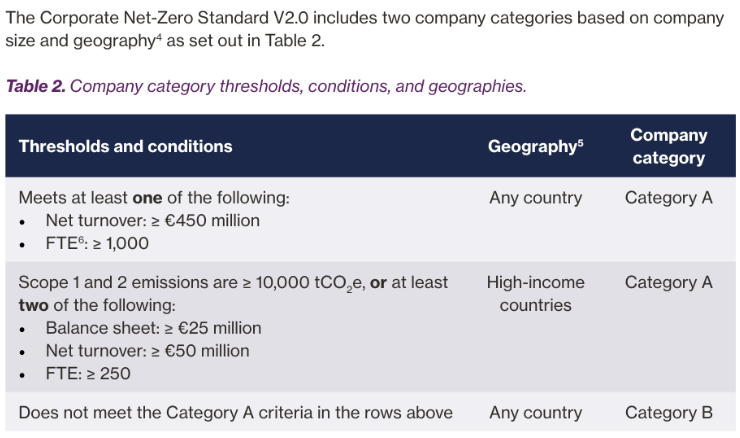
- Category A companies with annual electricity consumption greater than 10 GWh must calculate, report, and obtain assurance for the percentage of low-carbon electricity used, contracted, or matched on an hourly basis.
- Category B companies are not required to disclose the hourly matched percentage, but they may report this voluntarily.
The SBTi has also proposed an optional recognition programme with progressively increasing hourly matching thresholds:
- 50% by 2030
- 75% by 2035
- 90% from 2035 onwards
Participation in this programme is voluntary.